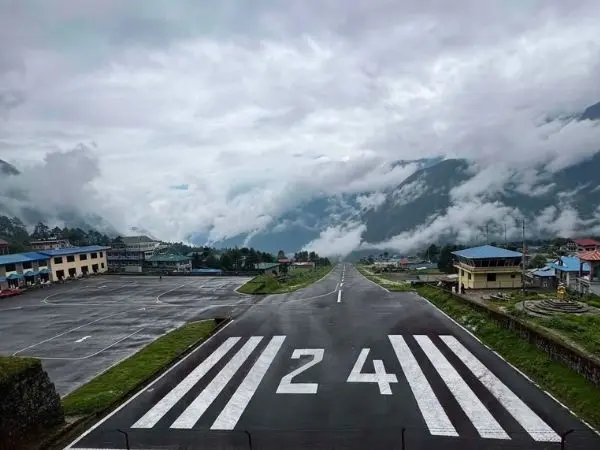
Lukla Airport Nepal also known as Tenzing Hillary Airport is the gateway to the Everest region, that connects trekkers, climbers, and essential supplies for Everest Base Camp, Namche Bazaar, and surrounding trails. Sitting at about 2,860 meters (9,383 ft), the airstrip links remote mountain communities to Kathmandu and is the busiest high-altitude civilian airport in Nepal. Flights are short but vert essential, and most treks begin or end here, making Lukla Airport a logistical hub for permits, gear last-minute buys, and porter or guide meet-ups.
Lukla Airport is also famous for its challenging and sometimes dangerous approach because of its short and sloped runway carved into a mountainside, changeable mountain weather, and strong winds which make takeoffs and landings demanding even for experienced pilots. Despite of these risks, the dramatic scenery, adrenaline of the arrival, and the airport’s role in opening access to the Khumbu region keep it iconic among mountaineers and adventure travelers.
Where Is Lukla Airport and Why Does It Exist?
Lukla Airport sits in the Khumbu Pasang Lhamu rural municipality of Solukhumbu District, in Koshi province, at an elevation of about 2,846 meters (9,341 ft). Tucked into a steep mountainside above the Dudh Koshi valley, it serves tiny, scattered Sherpa villages and the entire Everest trekking circuit. With no practical road access between Lukla and Kathmandu or other lowland hubs, the airstrip functions as the region’s lifeline, carrying trekkers, climbers, fresh supplies, mail and medical evacuations. Its existence supports local economies, enables tourism-dependent livelihoods (lodges, guides, porters), and shortens journeys that would otherwise take many days on foot.
The History of Lukla Airport: Built by Hand, Named for Legends
Construction of the Lukla airstrip began in 1964 under Sir Edmund Hillary’s initiative to open the Everest region, and much of the early work was done by hand with local Sherpas and villagers because heavy machinery couldn’t reach the site. Hillary reportedly bought the land after local farmers were reluctant to give up flat farmland, paying about USD 2,650 and involving the community in building the airstrip. However the problem was poor soil resistance, and it is said that Hillary purchased local liquor and encouraged Sherpas to perform a foot-stomping dance to compact and level the runway surface. The Lukla Tenzing Hillary Airport surface stayed gravel until it was paved in 2001.
In 2008 the airport was officially renamed Tenzing-Hillary Airport to honor both Tenzing Norgay and Edmund Hillary for their roles in opening access to the high Himalaya.
Why Is Lukla Called the World's Most Dangerous Airport?
Lukla’s reputation as one of the world’s most dangerous airports comes from a rare and unforgiving combination of features. The runway is extremely short, with a sheer mountain wall at the uphill end and a sudden drop into the valley at the downhill end, leaving virtually no margin for aborted takeoffs or landings. Pilots must execute precise, one-way approaches and departures often in gusty, changeable mountain weather, with visibility reduced by clouds, wind-driven snow, or afternoon turbulence.
The airstrip’s high-elevation location also means thinner air and reduced aircraft performance. Operational challenges, tight scheduling, high traffic during peak season, and occasional runway surface issues really add the risk, which is why authorities, carriers, and pilots take conservative weather and safety decisions for every flight.
Inside the Runway: Slopes, Dimensions, and Why Planes Land Uphill
Lukla’s runway is short and steep by design which is about 527 meters long, 20 meters wide, and with an uphill gradient of roughly 12%. But this slope is actually functional where planes land uphill so the incline helps decelerate the aircraft quickly, and they take off downhill to gain extra acceleration in the short distance available. The uphill mountain face at one end and the valley drop at the other force one-direction operations and precise speed control, so pilots use powerful short-takeoff-and-landing (STOL) aircraft and careful technique.
How Weather Controls Every Flight Landing and Take Off on Lukla Airport ?
Mornings are usually calm with stable visibility, so airlines schedule most departures at first light to land on Lukla Airport. By mid-to-late morning valley winds often gets strengthen, bringing clouds, turbulence, and rapidly changing visibility that can force the Lukla flight cancellations. During the monsoon months, heavy rain, low cloud and poor visibility can close the airport for days. In winter, frost, snow, icy conditions, wind around the ridge, and rapidly forming fog means pilots and operators must make conservative go or no-go calls, so flexibility and buffer days are really essential for trekkers.
Flight Delays and Cancellations: What Every Trekker Should Expect
Delays of one to several days are common for flights in Lukla airport because of an unstable mountain weather conditions which can change really fast. So, trekkers should build buffer days into itineraries and keep plans flexible. As airlines prioritize safety, even booked flights can be postponed if visibility, winds, or cloud covers the runway. During the monsoon or winter these disruptions become more frequent and sometimes last several days. So, its important to bring extra cash for your personal stay if trip gets delay. However, we Mount Face Nepal adds extra days in our trekking itinerary in case journey gets delayed, so you won't have to worry much.
How Much Does a Flight from Kathmandu to Lukla Cost?
A one-way flight to Lukla typically costs foreign nationals between about $215 and $258 USD, though exact fares vary by airline, season, and how far in advance you book. Prices rise during peak trekking months (spring and autumn) and around holidays, while low season can bring slightly cheaper seats but higher cancellation risk from poor weather. However, we Mount Face Nepal include Lukla Cost within the trekking package in Khumbu region, so you won’t have to book yourself, letting you to fully focus on journey rather than logistics.
Kathmandu to Lukla flight Cost breakdown by Passenger Nationality
| Passenger Nationality | Cost (One Way) |
| Foreign Nationals | $215 to $258 USD |
| Nepali Citizens | 10,340 to 12,200 NPR |
How to book flight ticket for Lukla?
You can book your Lukla flight through a trusted Nepal-based trekking agency like Mount Face Nepal or directly through an authorized airline. Travelers are required to send the passport details and travel date in advance. As plane seats fill quickly in peak season and weather can change plans, it’s highly recommend to reserve early and reconfirm your ticket 48–72 hours before of departure. We Mount Face Nepal handle payment, rebooking, and cancellation support, which is useful if your Kathmandu to Lukla or return flights are delayed or shifted.
Is Lukla airport the only option to enter Solukhumbu region trekking?
No, Lukla airport also known as Tenzing Hillary Airport is not only the way to enter the Solukhumbu trekking region. While it is the most popular and convenient gateway for Everest-area treks, travelers can also use Phaplu Airport as an alternative and then continue overland. Another classic option is the Jiri-to-Everest route, often called the “Pioneers’ Route,” where trekkers drive to Jiri and hike for about 4 to 6 days before reaching Lukla. This adds roughly a week to the Everest region Trekking itinerary but offers excellent acclimatization and a more traditional trekking experience. In the future, maybe after 5-6 years a road connection from Lukla toward Kathmandu may also reduce dependence on flights, though for now air travel remains the fastest and reliable access.
Tips for a Smooth Journey Through Lukla Airport
For a smoother journey through Lukla Airport, it’s important to plan to fly as early in the morning as possible, since weather is usually calmer and flights are more likely to operate on time. It’s also wise to build in 1–2 buffer days in your Everest region trekking itinerary, because delays and cancellations are common in the Lukla Airport Nepal. Additionally, keep your backpack light, as baggage weight limits are strict because space is limited on small aircraft. Most importantly, travelers need stay flexible with their respective plans or itinerary while choosing reliable agency like Mount Face Nepal who can assist with rebooking if needed.